How do I get my website discovered in 2026?
The way people find information online has obviously changed since the world wide web was first piloted in 1993. Entering into 2026, those changes are more apparent than ever.
That being said, the biggest mistake you can make when trying to help your website keep up with these changes is to overcomplicate your approach. The core best practices at the heart of web search remain the same, and they aren’t going anywhere. Here’s a list of best practices for your SEO and AI optimization strategies.
Write helpful content for your audience
The biggest thing you can do to get discovered by your audience is meet them where they are. Whether they use traditional search engines or AI answer engines, your target customers are probably interested in the same set of topics and asking the same questions.
Address what they actually care about
Content is king, but only if it actually serves its intended audience. Make sure your content strategy is aligned with the issues that matter to your audience. A great way to do this is to meet with your sales team to find out the questions that keep coming up in discussions with prospects and customers. Get into the habit of doing this on a regular basis so that your content reflects current trends and questions in your industry.
Address it in a way that is helpful to them
The majority of the time people turn to the web and AI search, they are asking specific questions, like “What is the best way to clean my gutters?” or “How much does it cost to remodel a bathroom?”. The best way to grab their attention is to provide direct, empathetic answers. Use clear headings and a detectable document structure to get them to their desired information as quickly as possible.
Having clear, direct answers is a core tactic for Answer Engine Optimization (AEO), or the subset of AIO focused on getting your website synthesized in AI summaries.
Make sure that content is formatted for search engines and AI
Use semantic structure
Web pages shouldn’t just be random assortments of words on a screen. They should follow a clear structure, like chapters in a book.
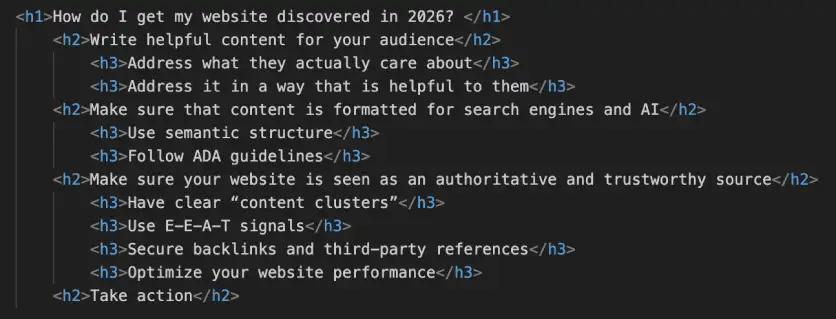
This is semantic structure, a classic technical SEO best practice that involves making sure that all of your HTML elements fall in the proper order. This is primarily done by making sure that your heading tags (ex: <H1>, <H2>, <H3>) are ordered correctly.
A good litmus test about the clarity of your content is to skim through the headings of your web pages and figure out if they tell a complete story. This is a good indicator that search engines and AI are able to digest your content and match it to user’s queries.
If you want to see an example, read through the headings on this page. All of the main section headings (H2s) are supported by their subsection headings (H3s), and they all work together to answer the question posed in the page heading (the H1).
Follow ADA guidelines
In case you are unaware, The Americans with Disabilities Act applies to websites, too. Certain standards are in place to make sure that those with visual, auditory, or physical impairments can still interact with websites. Some of these standards include:
- Ensuring every image uses Alt text
- Using an adequate color contrast for text and backgrounds
- Ensuring that your website is navigable using only the keyboard
Meeting ADA standards isn’t just the law (if you don’t, it is possible that you will get sued!) but it is also a best practice for SEO and AIO. Search engines prefer accessible websites when ranking results, and AI answer engines can digest websites more easily when they are built according to ADA standards.
Make sure your website is seen as an authoritative and trustworthy source
Have clear “content clusters”
When AI engines look for websites to cite in generative search results, they often turn to websites that feature high-volumes of content related to the topic being searched. These “content clusters” signal what topics your company is an authority on, and they are a best practice for Generative Engine Optimization (GEO), the subset of AIO focused on getting cited and even recommended by AI.
Use E-E-A-T signals
E-E-A-T is a framework developed by Google to rate the reliability of a website based on the following factors:
- Experience: Does the publisher have first-hand experience with the topic being discussed?
- Expertise: Does the publisher show credentials relevant to the field?
- Authoritativeness: Does the publisher have a good reputation in this field? (this is primarily determined by backlinks)
- Trustworthiness: Does the publishing website signal that it is safe and that the information is accurate?
Investing in improvements to each of these factors is a helpful way to secure the favor of Google, Gemini, and other search and answer engines.
Secure backlinks and third-party references
While off-page SEO has always existed, AI search has made managing your reputation elsewhere on the web even more important. Securing quality backlinks by contributing to publications in your industry or having your content featured on other websites is a great way to build your authority.
For AI search particularly, third-party reviews have proven to be a very important resource. AI search engines often reference industry-specific review platforms when deciding which businesses to recommend to satisfy a user’s query. For example, as a marketing agency, we have found that our ranking on Clutch.co has made a big impact on how we are referenced in AI results.
Optimize your website performance
Technical SEO is still important in 2026. In order for search engines or AI to recommend your website, it must be functioning well, meaning that it can have any major issues that affect user experience. These issues could include problems with your website’s speed, visual stability, and interactivity. To see real data on how your website is performing, try using Google’s Page Speed Insights tool. Major roadblocks to your website performance typically require the help of a web developer to fix, but doing so will hopefully boost your search visibility.
Take action
The biggest factor holding many companies back from SEO and AIO success is inaction. The longer you delay getting started, the less time you have to grow your search banking and capture more of your audience. Your strategy doesn’t need to be perfect, just pick a best practice to implement and get to work!