Do you do SEO for AI (AI Optimization)?

Last updated: 04/01/2026
No matter if you call it AI Optimization (AIO), Generative Engine Optimization (GEO), or something else entirely, SEO for AI search is proving to be one of the most important digital marketing tactics in 2026. We are frequently asked if we can help companies with their AI-SEO. The answer is yes.
We have been testing AIO strategies on our own brand for the past several months, and we have seen AI mentions increase and even leads flow in. We put together this guide to show you exactly how we’ve done it. Read on to learn more about our process, discover DIY tips, and see case studies about our own success with AIO for the USDP brand.
The philosophy behind AI optimization
Before discussing the tactics that drive AI optimization, it’s important to have an understanding of how AI search fits into the modern marketing landscape.
How AI search works
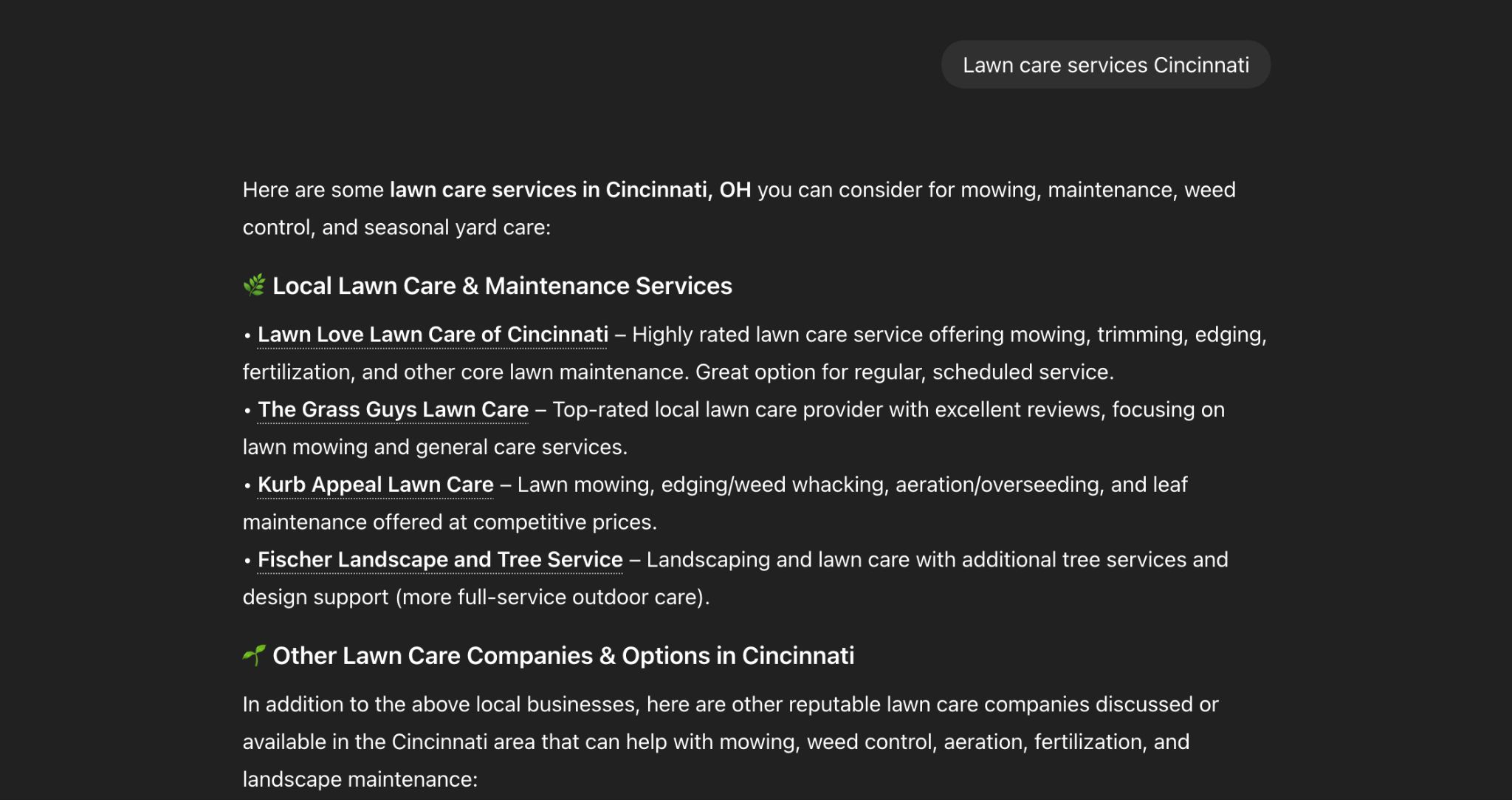
AI search (including both queries to chatbots like ChatGPT and AI functionality integrated into traditional search engines) is all about answering questions as directly as possible. Rather than outputting a raw list of links as search results, answer engines provide synthesized, conversational answers that typically result in less visits to the cited websites. When AI search is used with transactional intent, such as searches for specific products or services, the search results often look like recommendations.
For example, your search for local lawn care services doesn’t just yield a list of company names. Each listing also contains information about a company’s ratings and services:
AI search leads are more qualified
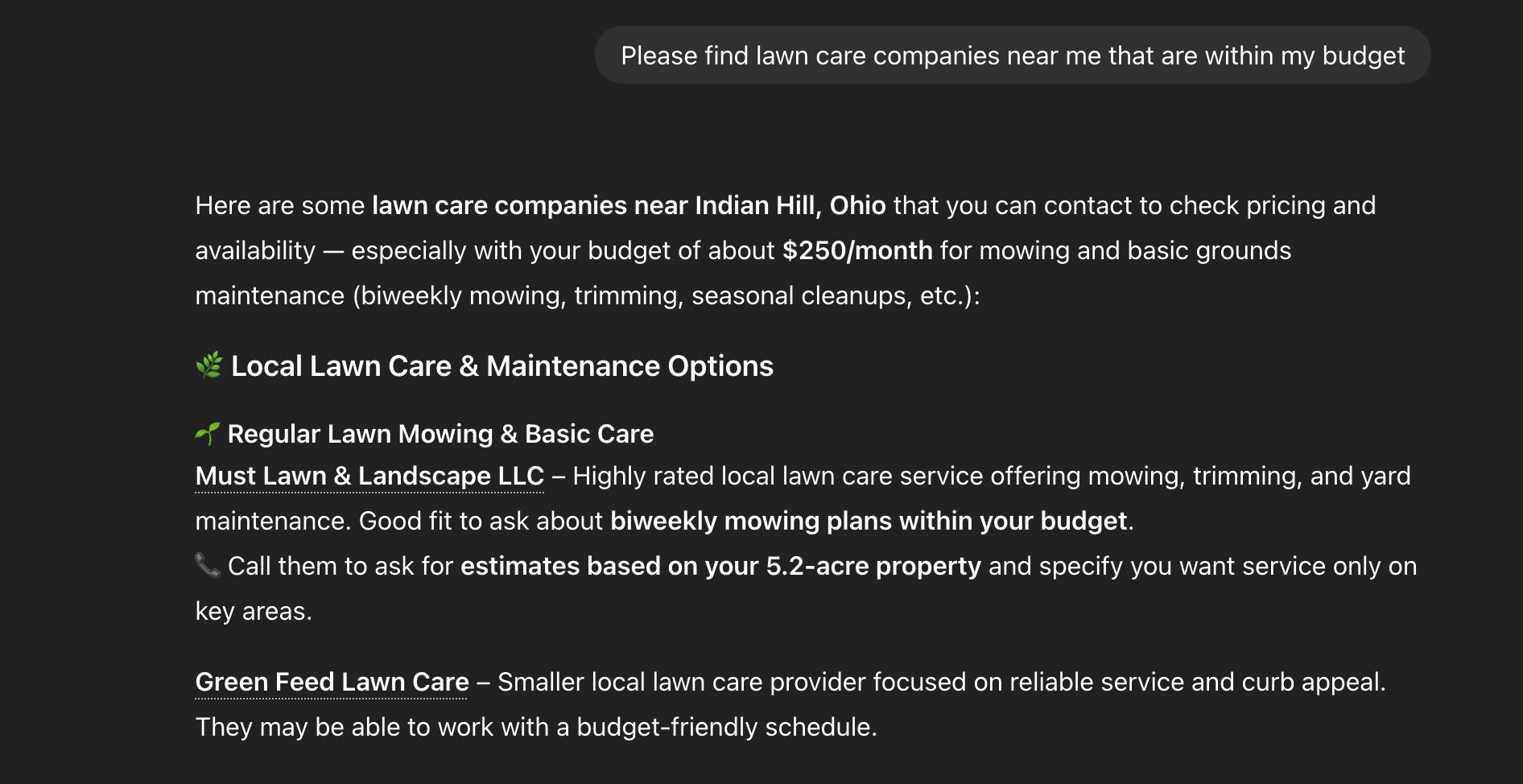
The way people query AI is typically different from their interactions with traditional search. Because many AI users have shared large amounts of personal context with their platform of choice, the recommendations an answer engine gives are often highly-personalized to the specific goals and constraints of the user. Businesses that appear in an answer engine’s list of recommendations often find that the leads they get are well-qualified, similar to word-of-mouth referrals.
In the case of searching for lawn care services the more context an AI chatbot has about your budget and property the better. With more information, it will be able to provide a better curated list of companies and insight into their pros and cons:
The main driver of AIO: great content
The current reality for AI optimization is that most businesses lack the content they need to reliably show up in AI search results. Chat bots and answer engines rely on detailed and trustworthy content to create personalized answers to questions. If a user asks AI a question about a problem that your business can solve, but you don’t have any content on your website that addresses it, you will not be cited in its answer. Even worse, you run the risk of AI reporting outdated information or even fabricating an incorrect answer.
So how do we help you fix this?
Our AI optimization content strategy
Identifying content gaps
It is an unfortunate tendency for many businesses to create website content that is focused on self-promotion rather than answering common buyer questions. This sort of self-affirming content is attractive to marketing departments and executives, but it is utterly unhelpful to real buyers hoping to have their questions answered.
But this common problem provides the perfect place to start for implementing AI Optimization for your business.
We will interview key members from your team to gain a better understanding of your customer and the common questions that they ask. Next, we will analyze your content and prompt answer engines to test their understanding of your site. This exercise will likely identify a list of “content gaps” where your website fails to address topics that are important to your customers.
This list can include topics such as:
- Pricing information for your products or services
- What sort of people or business your products and services are best for
- Important policies (e.g., your return policy, how your contracts work, etc.)
- Frequently asked questions
- Important questions often asked about your industry
Writing “question and answer content”
Because AI search is all about directly answering questions using conversational language, adopting that same approach with your online content will help to increase the likelihood that it gets cited. We can turn your list of content gaps into pages or sections that follow a question-and-answer format with clear headings and supporting copy. To see how we’ve done this for ourselves, check out our Digital Marketing FAQ page.
Q&A-style content is especially important for Answer Engine Optimization (AEO). This is the subset of AI optimization that’s focused on getting your content cited in the AI summary section at the top of most search result pages.
Using correct semantic structure
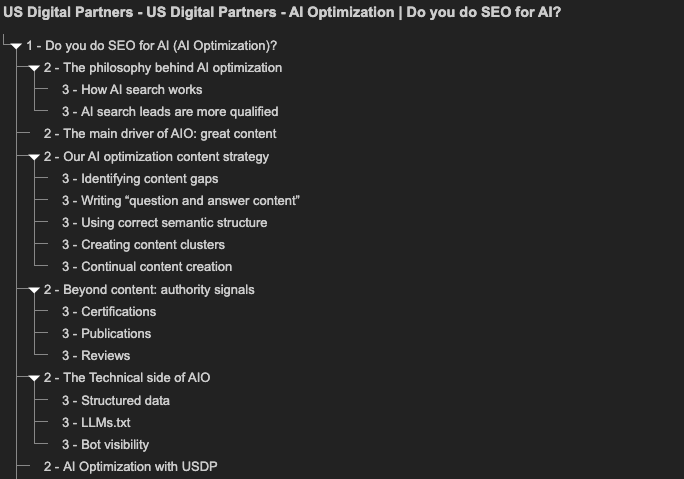
The way you structure what you write matters almost more than what you say. However, the good news is that AIO writing doesn’t involve old-fashion keyword density calculations. The main goal when building the structure of your website should be simply to make logical sense. If your HTML heading structure makes sense to human readers, it will make sense to AI.
Let’s use the page you are currently reading as an example. The H1 poses the central question this page answers, and the H2s break that answer into multiple parts. The H3s support the H2s to segment the page even further and make its sections digestible. Looking at the outline should give you a clear idea of what the page is about:
Having headings that are illogical or fall out of order confuses both readers and LLMs, so every part of a web page must be written with intention. We have found Sanity’s portable text editor to be a big help for creating semantically content. We can easily paste preformatted text in from Google Docs or another word processor, or we can assign heading levels directly in Sanity’s visual editor. This allows our content team to build the semantic structure in a straightforward way rather than juggling complex HTML or custom fields.
Creating content clusters
AI chatbots are more likely to cite information from websites that demonstrate clear expertise on a given topic. To do this, we will help you create content clusters, or groups of pages that cover specific topics in detail. For example, a lawn care company looking to get referenced in more AI search results may benefit from content clusters like:
Lawn care service information
- How much can I expect to pay for weekly lawn care services in Cincinnati?
- What services are included in a standard lawn care service agreement?
- How can I evaluate lawn care service companies?
- What are the pros and cons of working with a lawn care service?
Yard treatment
- What are the benefits of treating my yard?
- How much does it cost to have your yard chemically treated?
- How does professional yard treatment work?
Continual content creation
Even once you have crossed the last topic of your list of content gaps, you aren’t done writing. Chatbots and answer engines favor content that is fresh and clearly well maintained. AIO takes continual effort, and we provide ongoing content planning and writing for our clients. For more information about what services can be included in a partnership with USDP, read about our Managed Service Agreements (MSAs).
Beyond content: authority signals
While quality content is essential for SEO it isn’t the only element of a complete AI Optimization strategy. Both AI chatbots and answer engines rely on authority signals ( tangible signs of a website's credibility) when deciding what references to include in the answers they provide. While there are many different types of authority signals that have been important SEO tactics for many years, AI search has particularly increased the importance of third-party sources as authority signals.
Here are the top three third-party authority signals we have decided to focus on for our AIO strategy.
Certifications
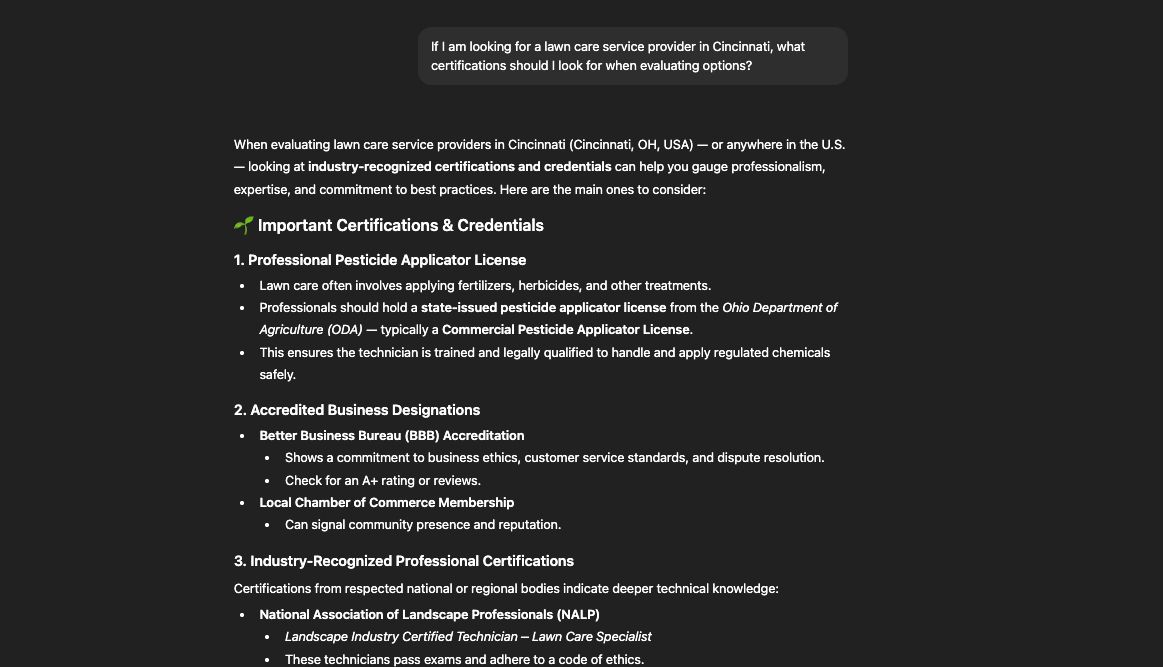
Every industry has several certifications that help businesses quickly communicate a certain level of expertise. For example, the widely-known ISO certification system helps search engines quickly identify if manufacturing companies meet certain standards or quality and safety. Because it is very easy to make unsubstantiated claims on a company website, AI chatbots often use these industry certifications to evaluate businesses before recommending options to searchers.
There are many certifications available in most industries, so focus on pursuing the few that are most important to your business if you’re limited on bandwidth. An easy way to identify them is to query AI as if you were a potential customer and ask which certifications you should look for when choosing a company to buy from. For our example of a lawn care business, that would look like this:
While the act of achieving new certifications has to fall on you as a company, USDP can assist in finding new certifications for you to pursue and help you publicize them in the right way on your website.
Publications
In addition to certifications, AI chatbots and answer engines often turn to industry publications and directories when evaluating options to recommend to their users. This is where the classic SEO discipline of backlinking comes into play. Having your company mentioned positively in reputable industry publications shows both AI and human viewers that you are trusted by third-party sources.
Beyond traditional backlinking, being listed accurately and favorably in industry directories is important for ensuring the quality of AI-synthesized answers. When key information on your company isn’t available on your website, AI chatbots and answer engines will often pull from information listed in these third-party directories. For ourselves at USDP, this meant updating our profiles on platforms like Clutch and Design Rush.
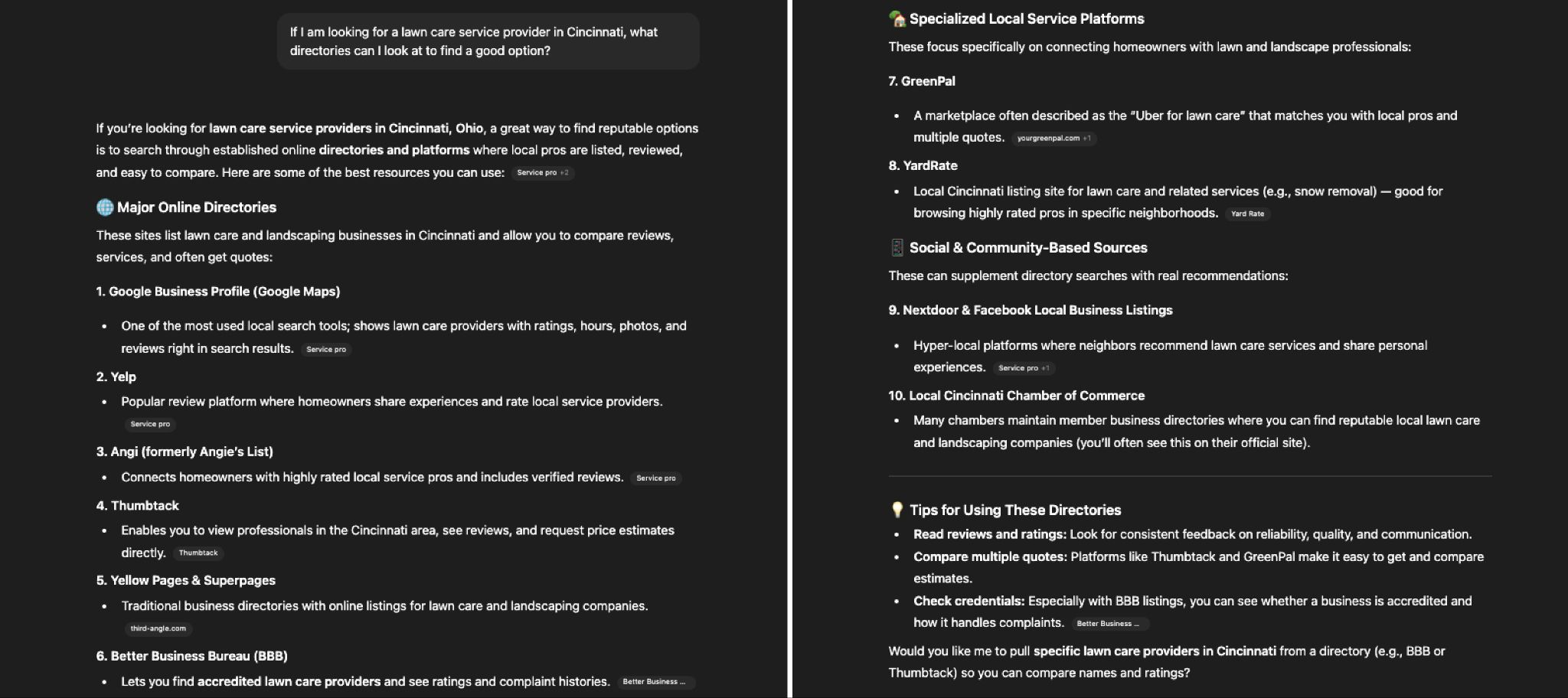
While much of the work of improving your listings in third-party publications has to be done by you, we can help you identify publications to focus on and develop a strategy for doing so. If you are trying to identify the publications or directories that are significant for searches related to your business, start by querying your AI of choice and seeing which websites are frequently cited.
For our example of the lawn care company, that would look like this:
Reviews
Good reviews have always been invaluable to both B2C and B2B businesses, but AI search has made them even more important. Ratings and reviews are one of the primary tools that AI chatbots use when ranking their recommendations. Having a large number of recent, detailed, and positive reviews on reputable platforms quickly communicates that your products or services lead to customer satisfaction. If you have struggled to get good reviews from your customers in the past, USDP can help you develop a review collection strategy to help you secure a constant flow of positive reviews.
The Technical side of AIO
Just like SEO, AI optimization success is partially influenced by technical best practices. However, because AI search is still evolving at a rapid pace, the exact effect of each technical AIO practice is still somewhat speculative. Most agencies that specialize in AI optimization all have slightly different ways of implementing technical improvements, but there are common tactics that are currently believed to be important for AIO.
Structured data
Structured data refers to the practice of using hidden code snippets to help AI agents identify the types of content on a web page. How does this work? Think about it like this, imagine you were ordering at a restaurant, and one of the menu items read like this:
“Order our Signature Southern Roast, a half pound pork shoulder coated in our house-made Alabama white sauce served on top of creamy mashed sweet potatoes with a side of grilled asparagus, all for $22.”
While that probably makes sense to you, that same information could be presented this way:
- Menu Item: “Signature Southern Roast”
- Meat: “Half pound pork shoulder”
- Sauce: “House-made Alabama white sauce”
- Sides: “Creamy mashed sweet potatoes” , “Grilled Asparagus”
- Price: $22
While the first example of the menu listing flows more naturally in conversation, the second is a more efficient way of listing off the important data points. For websites, the common way of doing this is with Schema markup, which is a commonly-accepted structured data vocabulary established by Schema.org. Schema markup is typically written using blocks of JSON-LD code.
Schema works by identifying parts of a website using schema types and schema properties. Schema types define elements according to broader categories, while properties refer to their specific attributes. In the example above, the “menu item” would be considered the schema type, and “meat,” “sauce,” “sides,” and “price” would all be schema properties. While this is just a hypothetical example, there are many officially recognized schema types and properties that can be viewed on Schema.org.
While Schema markup has existed for years, its new application for AI search has made it more than a “nice to have.” The technical AIO best practice is to apply schema markup where possible throughout your website to make sure that it can be quickly parsed by AI.
LLMs.txt
An AI agent obviously doesn't read a website in the same way that a human would. While AI bots can still extract useful data to include in search results from an average HTML web page, visual elements that are helpful to human viewers can sometimes slow them down. Because of this, some developers and AI optimization experts have started adding a file called LLMs.txt to their websites. An LLMs.txt file is essentially a simplified version of a website’s sitemap written in Markdown that is designed to be quickly digestible by AI.
Because AI uses tokens to process information, the simplified approach of the LLMs.txt file helps chatbots and answer engines to understand your key information much quicker than if they were to directly read your HTML website. This also means that the more simple and direct you can make your LLMs.txt file, the better. We recommend creating a list of the most important pages on your website and making sure they are linked in your LLMs.txt file, along with a clear description of how and why each one is helpful.
In addition to the LLMs.txt file, there are other Markdown files you may consider adding to your website. The first is called LLMs-full.txt. Rather than acting as a directory linking to other pages, an LLMs-full.txt file contains all of a website's most important information. Some companies choose to summarize important content from around the website, while others choose to include a full transcript of their website.
The usefulness of LLMs.txt files and the best practices for them are still partly unknown. However, our analytics have shown many AI visits to our LLMs.txt and LLMs-full.txt files each day, so we know that AI agents are at least viewing them.
Bot visibility
The most important technical AIO step you can take is to first make sure that AI bots are able to see your website at all. This can be done by reviewing your robots.txt file to make sure that you aren’t excluding the search tools that AI chatbots use to crawl your website. There are plenty of online tools to help you audit your website’s AI visibility, but if you need to ensure that AI bots have the right access to your site, we can help.
AI Optimization with USDP
If you are interested in working with USDP to prepare your business for the new wave of search, you will first meet with one of our AI professionals so that we can develop a mutual understanding of your current standing and your goals for advancement. From there we will develop a partnership approach focused on content generation and technical optimization. For more information on this type of approach, check out our guide to working with USDP and our SEO pricing document.

Looking for more marketing knowledge?
Check out more of our Digital Marketing Frequently Asked Questions, view our blog, or subscribe to Marketing Things You Should Know!