If you are trying to improve your SEO and AI optimization, but you’re mainly focused on perfecting the homepage of your website, you’re doing it wrong.
In order to get in front of the right people, you will need an SEO/AIO strategy that is built around the way people actually shop.
Allow us to explain:
People Aren’t Searching for You
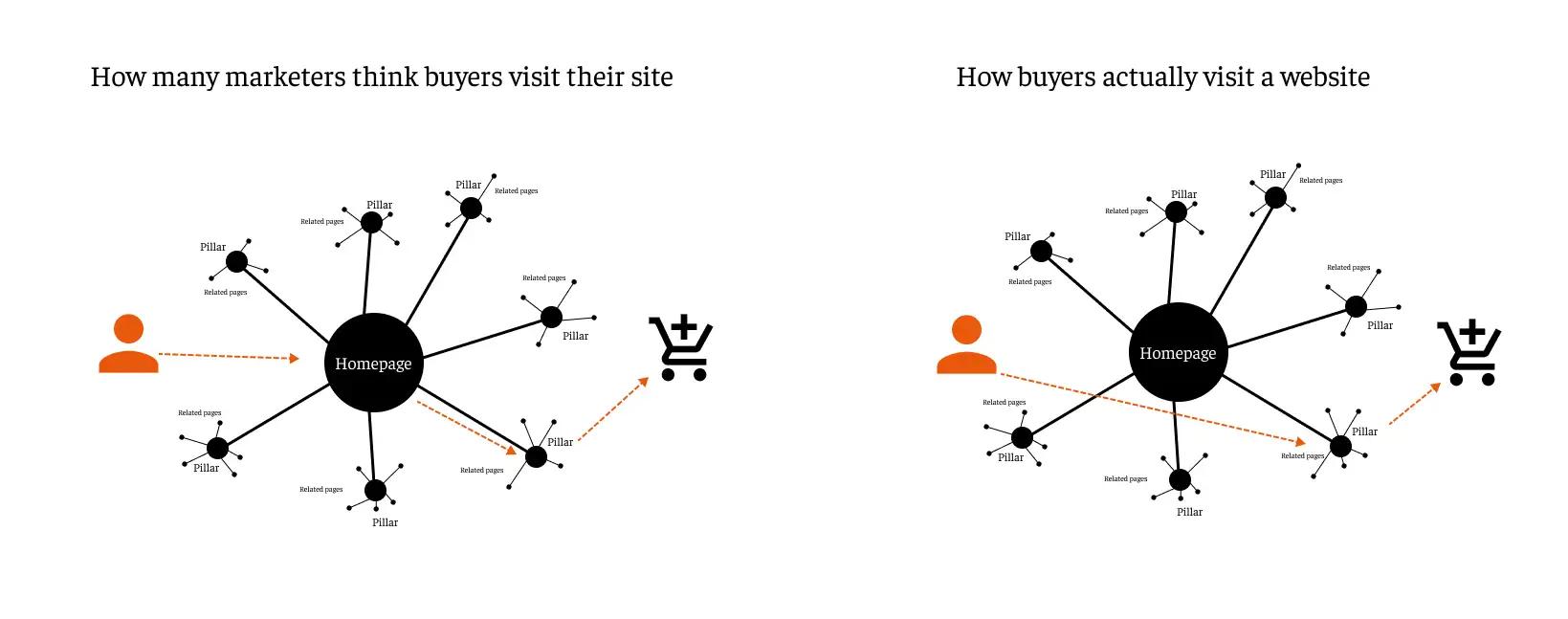
Unless you have achieved award-winning brand dominance in your industry, people aren’t actually shopping for your brand right out of the gate. Your audience is made up of specific people searching for specific solutions to specific problems. Those people usually don’t find their way to your site through your homepage; homepage-first traffic typically comes from branded searches or people who fit your broadest demographic.
Most high-intent buyers first come to your website on a specific landing page. Realistically, this makes the landing page the “gateway” to their experience on your website, not your homepage. The job of a marketer is to build specific shopping experiences around each of these entrances.
LLMs and Web Crawlers Function Like People
Artificial intelligence is modeled after human intelligence. Just like people, it identifies the shortest route to its destination. This means that your pages, semantics, and structured data should be defined by the common customer "entrances" and journeys that stem from them.
A Practical Analogy: Grocery Shopping
Let’s think about the similarities between an in-store shopping experience and browsing a website. Both customer journeys follow the same steps, even if you don’t realize it.
Entrance/Landing Page
Most people walk into a grocery store with a plan. They have a list of things to buy, and their goal is to find them as efficiently as possible. Their customer journey doesn't start once they enter the store. It starts even as they are choosing a parking spot.
Most grocery stores are designed with clearly marked entrances that are mapped to common customer journeys. Rather than funnel all customers into one general entrance and risk overwhelming them or scaring some away, most stores give shoppers a clear place to start their journey. Even if they need items from multiple areas of the store, providing them with a few defined starting points changes their shopping experience from disjointed to linear, thus increasing their satisfaction and willingness to return.
Landing pages on a website play the same role.
A website landing page only has a few seconds to make a good impression before a client decides to dwell or bounce. It should instantly present visitors with a clear path toward what they are looking for. For example, even though we are a full-service marketing partner, we know that most of our customers first come to us with one or two specific needs in mind. Because of this, we have specific landing pages and supporting pages for each of our services. This gives high-intent customers assurance that we can meet the needs they care the most about.
When considering optimizing for AI search, landing pages get even more important. LLMs are programmed to satisfy user queries as efficiently as possible. When browsing and listing results, they look for specificity. Providing an AI search assistant with defined in-doors gives them less reason to pass you over when finding answers for their clients.
Sections and Navigation
Think about the way you go grocery shopping at your favorite store. You probably follow a similar route every time you visit. You know roughly where the items you need are located, and you may even write your list in the order in which you will walk through the store. If you don’t know which aisle a specific item is located in, you can probably use context and signage to find it on your own. You have a mental map of the store, you use it to efficiently navigate to your desired items, and you predict where others might be.
The navigation of a website should provide users with a similar experience. It should follow expected norms while also providing enough context for users to intuitively find unfamiliar sections on their own. However, AI search takes things a step further. As previously mentioned, AI search assistants are built for efficiency. They don’t spend time clicking through navigation like human users do. They use high-level context of the website to build a knowledge graph that serves as their map for finding the exact information. This is why it is vitally important to have interlinked content clusters around your most valuable topics. This gives LLMs the guideposts they need to get in the door to the desired information.
What Does This Mean for Your Website?
Hopefully, this comparison either has you feeling more confident in your website or inspired to make some improvements. Either way, we want to leave you with a few more pieces of practical advice that you can use to improve both your content and technical SEO/AIO strategies.
Lead With What’s Important
Your landing pages are only effective as in-doors if they contain the right information. Make sure that you are listing the information that is important for your intended audience. This could include things like pricing, product specifics, service capabilities, FAQs, and more. Including the right information will result in better citations in AI search.
Create Content Clusters
Remember, context is crucial. Creating large amounts of interlinked content gives both people and AI search assistants the context they need to navigate your website. Think about the signs that hang above aisles in grocery stores. The more product categories listed on a sign, the more confident you can be that an item is or isn’t in a particular aisle. Create content that gives your customers and their agents the confidence to quickly find what they are looking for without bouncing.
Build Schema Around Customer Journeys
You are probably aware that schema markup is crucial for AI-SEO. Like every other marketing and SEO tactic, schema markup shouldn’t be applied haphazardly. When you are adding schema to pages, consider which customer journey is relevant to each page, and add the schema types that make the most sense.
If your website hasn’t been seeing the amount of traffic you are hoping for, it’s time to get to work making improvements. We’ve hopefully given you enough direction to get started on your own, but if you need help digging deeper, reach out. Our team loves solving problems like this, and we won’t back down from a challenge.